

Investment Management Newsletter - 2nd Quarter 2022
Inflation, Interest Rates, and Investing
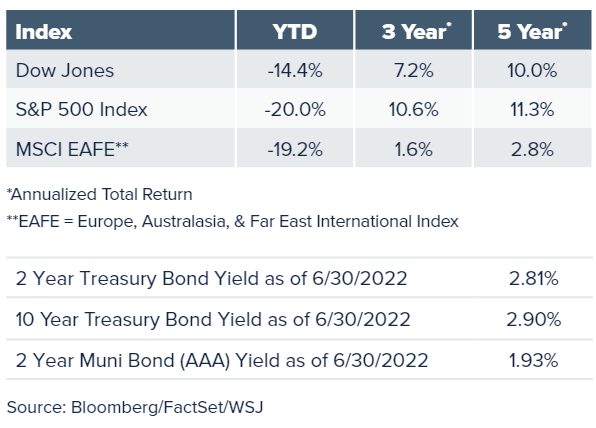
After stocks returned a cumulative 100% from 2019 through 2021, the first half of 2022 saw major indices give back some of those unusually strong returns. The S&P 500 was down 20.0% (total return) for the year-to-date as of June 30 as it entered a bear market. The technology-heavy NASDAQ composite fell 29.2%, while mid and small cap stocks were down by 19.6% and 19.0%, respectively. Foreign stocks did not escape the bear either. Developed international equities, as measured by the MSCI EAFE index, fell 19.2% and emerging markets, measured by the MSCI Emerging Markets index, were down 17.6% for the same period.
The declines resulted from a combination of factors, including rising oil prices, supply chain issues, and fears of a recession. Elevated readings for the headline consumer price index, which recently hit 8.6%, drove consumer sentiment to its lowest reading in 50 years. With inflation running well above the Federal Reserve’s 2% target, and with even higher producer price inflation suggesting higher consumer prices to come, the Fed embarked on an aggressive interest rate hiking cycle in March aimed at slowing aggregate demand and rising prices. Rates increased by 0.25% in March, 0.50% in May, and 0.75% in June. The Fed is expected to continue raising rates during the second half of the year while further tightening monetary policy by shrinking its bond portfolio.
The move to a tighter monetary policy dampened the market. Despite the softness, there were several bright spots. Value stocks, as measured by the Russell 1000 Value Index, meaningfully outperformed the S&P 500 by over 7 percentage points and outperformed growth stocks by over 15 percentage points. Our own value-oriented dividend focused strategy bested its index by a wide margin. Within the value space, energy stocks were particularly strong with a positive return of 31.4% for the sector during the first six months. All other sectors have posted negative returns for the year, with Consumer Discretionary faring the worst with a 32.5% year-to-date drop.
Are We Out of the Woods?
Higher interest rates tend to slow the real economy after a lag of roughly 12 months. This suggests economic growth could become sluggish as rate hikes continue. After a 1.6% contraction for the first quarter of 2022, largely due to reduced net exports and weak expectations for the second quarter, GDP is already softening, implying elevated chances of a recession. The average recession going back to the 1920s lasted 14 months while the last 13 bear markets saw an average decline in the S&P 500 of 32.7%.
In this environment, we expect stocks will remain volatile. A bounce in equity prices is likely, but the timing is uncertain. The last time the S&P fell by 20% during the first half of a year was in 1970, and the index was up 26.5% during the second half. In addition, of the seven times the S&P 500 has dropped by more than 20% over two consecutive quarters, stocks were positive a year later each time. Seasonally, the last several months of the year tend to be among the strongest. Furthermore, much of the damage has already been priced into many stocks, particularly in the Information Technology sector where valuations are becoming compelling. To that point, this has allowed us to add stocks like NVIDIA and Intuit to our core stock portfolios at attractive entry points. Finally, the forward price/earnings ratio for the S&P 500 of 15.9 as of quarter-end is below its 25-year average of 16.9, meaning the market is attractively priced on a relative basis. All of this underscores our long-term optimism, despite the possibility of continued short-term volatility.
When we set investment objectives with clients, we know that one year out of every four tends to be negative for stocks. Even with two bear markets over the last 28 months, the S&P 500 remains 16% above its pre-COVID peak on a total return basis. Patience pays. Stock prices do not move in a linear fashion. Notably, roughly half of the very best days for the market tend to occur during bear markets and another quarter of them come within the first two months of a bull market before investors typically realize an inflection has occurred. Over the short term, stocks may continue to experience rough waters, but after a healthy repricing, the long-term outlook looks 20% better than it did at the start of 2022.
What Happened in the Bond Market?
Fixed income can often serve as an effective hedge against equity risk because bonds and stocks usually move in opposite directions. Whereas stocks have negative years roughly 25% of the time, on average, the Bloomberg US Aggregate Bond Index (the “Agg”) has registered negative returns during only four calendar years out of the last 46. The worst year was 1994 when the Agg dropped 2.9%. However, increasing interest rates cause bond prices to fall. That, as well as widening spreads (yield differences among bonds of differing credit quality), led to an unprecedented decline of 10.3.% for the Agg during the first half. Municipal bonds were down 9.0% and high yield was down 14.2%. Fed hikes increased short-term interest rates, but market action caused the yield on the 10-year US Treasury to more than double from 1.51% at year-end to a peak of 3.49% before settling to 2.90% at quarter-end. The difference of just 0.09% between the yields of the 2-year and 10-year Treasury signals that the market expects the economy to slow.
Alternative Assets
As expected, assets with low correlations to traditional stocks and bonds have tended to outperform. The hedge fund HFR Index was down 4.8%, while gold was down just 1.3%, outperforming most other asset classes so far this year.
Finally
Downturns are difficult to digest emotionally, but they offer compelling opportunities for investors to buy assets at discounted prices. We remain relentless in our pursuit of quality assets and diversification consistent with client goals. We’ll leave you with a pearl of wisdom from Warren Buffett that we found timely after a challenging first half to the year: “The stock market is a device which transfers money from the impatient to the patient.”
Should you have any questions or comments, please email us at [email protected]. Written by our partners at Broadway Wealth Management Portfolio Management Group.
Written by our partners at Broadway Wealth Management Portfolio Management Group.
Disclosures:
WARRANTIES & DISCLAIMERS
There are no warranties implied.
Broadway Wealth Solutions (“BWSI”) is a registered investment adviser located in San Antonio, Texas. BWSI may only transact business in those states in which it is registered or qualifies for an exemption or exclusion from registration requirements. BWSI’s web site is limited to the dissemination of general information pertaining to its advisory services, together with access to additional investment-related information, publications, and links. Accordingly, the publication of BWSI’s web site on the Internet should not be construed by any consumer and/or prospective client as BWSI’s solicitation to effect, or attempt to effect transactions in securities, or the rendering of personalized investment advice for compensation, over the Internet. Any subsequent, direct communication by BWSI with a prospective client shall be conducted by a representative that is either registered or qualifies for an exemption or exclusion from registration in the state where the prospective client resides. For information pertaining to the registration status of BWSI, please contact the state securities regulators for those states in which BWSI maintains a registration filing. A copy of BWSI’s current written disclosure statement discussing BWSI’s business operations, services, and fees is available at the SEC’s investment adviser public information website – www.adviserinfo.sec.gov or from BWSI upon written request. BWSI does not make any representations or warranties as to the accuracy, timeliness, suitability, completeness, or relevance of any information prepared by any unaffiliated third party, whether linked to BWSI’s web site or incorporated herein, and takes no responsibility therefor. All such information is provided solely for convenience purposes only and all users thereof should be guided accordingly.
This website and information are provided for guidance and information purposes only. Investments involve risk and unless otherwise stated, are not guaranteed. Be sure to first consult with a qualified financial adviser and/or tax professional before implementing any strategy. This website and information are not intended to provide investment, tax, or legal advice.
Insurance products and services are offered and sold through BWSI and individually licensed and appointed insurance agents.
